Ash Cave-Haunted Attraction
Athens Asylum

Home Moonville Lady Moonville Brakeman Old Man's Cave Hope Furnace Conkle's Hollow Ash Cave Lady Ash Cave Lights Hocking Homestead Georgian Manner Ghostly Gray Cat Haunted Programs Ghost Pictures Athens Asylum Site Map


Where to get more info:

Map of the old property with buildings

Unique and old pictures of Asylum

More history on the Asylum


So what piques our interest with the asylum? Is it the idea that many patients were placed there beyond their will and may still be around lamenting their plight? Or is it the Asylum worker who was locked in an unused room and whose body left an imprint on the floor long after it had decomposed? Whatever our attraction to the ghostly aspect of Athens State Hospital, it attracts hundreds and hundreds of visitors a year hoping for a peak into the macabre.

Haunted Ohio-Athens Asylum

A little about the Asylum:

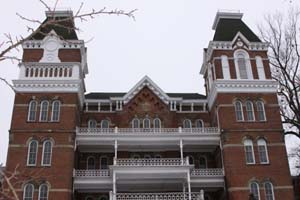
From 1874 to 1993, the Athens Asylum provided a safe haven for those with mental disabilities. It was originally built on land acquired from a local farmer, Arthur Coates.

The hospital was renamed within two years of its opening as the Athens Hospital for the Insane. Later the hospital would be called the Athens Asylum for the Insane, the Athens State Hospital, the Southeastern Ohio Mental Health Center, the Athens Mental Health Center, the Athens Mental Health and Mental Retardation Center, the Athens Mental Health and Developmental Center, and then (again) the Athens Mental Health Center. After the hospital's original structure closed, Ohio University acquired the property and renamed the area, The Ridges. However, the state hospital continued to function in Athens, with patients and staff relocating to a newly constructed facility on the north bank of the Hocking River. At the time of the transition in 1993, the new facility was called the Southeast Psychiatric Hospital.

The original hospital was in operation from 1874 to 1993. Although not a self-sustaining facility, the hospital for many years had livestock, farm fields and gardens, an orchard, greenhouses, a dairy, a physical plant to generate steam heat, and even a carriage shop in the early years. The architect for the original building was Levi T. Scofield of Cleveland. Construction of the facility began in 1868 and the hospital opened on January 9, 1874.

The designs of the buildings and grounds were influenced by Dr. Thomas Story Kirkbride, a 19th century physician who authored an influential treatise on hospital design, On the Construction, Organization and General Arrangements of Hospitals for the Insane. Kirkbride buildings are most recognizably characterized by their "bat wing" floor plan and often lavish Victorian-era architecture.


The history of the hospital documents some of the now discredited theories of the causes of mental illness, as well as the practice of harmful treatments, such as lobotomy. Disappointments, religious excitement, lightning strikes, PMS, and seduction are listed as causes of insanity in the early annual reports of the hospital. The leading cause of insanity among the male patients was masturbation, according to the annual report of 1876. In the first three years of the hospital, eighty-one men and one woman were diagnosed as having their insanity caused by masturbation.

When the hospital first opened, many patients there were Civil War Veterans suffering from post traumatic stress syndrome.

Children who would have today been diagnosed with ADD/ADHD would also have been committed by their parents because they were too much for them to handle.

Mothers with large families were known to commit themselves for a couple weeks just so they could take a break.

  1. During the 1950s, Walter Jackson Freeman, M.D., Ph.D., "The Father of the Transorbital Lobotomy," performed over 200 lobotomies on patients. Although now discredited as a treatment for mental illness, the surgery on the brain was an accepted medical procedure at the time.
  2. Multiple personality and convicted rapist, Billy Milligan (made famous in Daniel Keyes' book, "The Minds of Billy Milligan") was a patient at the hospital in the 1970s.
  3. The stain left by the decaying body of a 54-year-old female patient has fueled the speculation of those who believe in haunted places. She was found dead in an unused ward early in 1979, after she had been missing for six weeks.
  4. Interior images of The Ridges served as the visual setting for "How To Make Your Movie: An Interactive Film School", an interactive CD-ROM that was produced by Athens, Ohio based multimedia company Electronic Vision in conjunction with film director Rajko Grlic and the Ohio University Film School. [2]
  5. The Ridges was shown on Fox Family Channel's television show "Scariest Places on Earth" and claimed Athens, Ohio as the 13th most haunted place on earth. **


Please note: The caretakers of the Athens Asylum are promoting the beauty of the area and have provided trails through the cemetery and other areas that have returned to nature and were once dotted with buildings and brick roads. Please respect those who are buried here and those who have resided at the Asylum by staying on the trails and only going where you are invited.


Copyright  © 2003-Haunted Hocking-Heart of Hocking-Discover the wilder side of Ohio. The information provided is correct to the best of our knowledge. Ohio State Park hiking trails are closed from dusk to dawn. Please always call before you visit for changes in times or prices. Rates may vary and may only be listed as base rates. Site Design: 21 Crows / Heart of Hocking

Check out these sites for more information on Ohio and exploring its wilder side:  Heart of Ohio   Hocking Hills Cabin Rentals   Hocking Hills Visitors Guide  Hidden Hocking Hills   Ohio Weddings  Hocking Hills Weddings  Kid Friendly Places  Ohio Cabins  Cabin Adventures in the Hocking Hills Lake Erie Travel  Hocking Cabins   Old Man's Cave